 Naneedigital
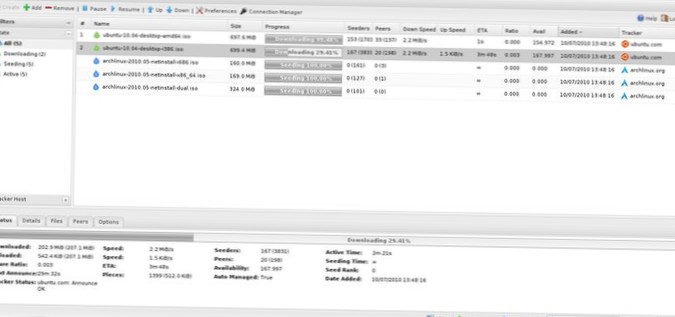
- How do I access deluge Webui?
- How do I use deluge console?
- How do I access my deluge remotely?
- Where is deluge config file?
How do I access deluge Webui?
You can now access the Deluge daemon, deluged, on the server via the GTK UI.
...
GTK UI
- In Preferences -> Interface and disable (untick) Classic Mode.
- Restart deluge and you should see the Connection Manager. ...
- Create a new entry with Add button:
How do I use deluge console?
deluge-console - Man Page
- Start the interactive console interface: deluge-console.
- Connect to a Deluge daemon instance: connect hostname : port.
- Add a torrent to the daemon: add url|magnet|path/to/file.
- Display information about all torrents: info.
- Display information about a specific torrent: info torrent_id.
- Pause a torrent: pause torrent_id.
How do I access my deluge remotely?
Switch to Remote mode
- In order to connect to your deluge headless daemon, you need to turn off the classic mode inside deluge:
- Restart deluge.
- Add your deluge IP Address to the connection Manager. Default username and password are: deluge.
Where is deluge config file?
Deluge can be configured through any of the clients as well as by simply editing the JSON-formatted configuration files located in $HOME/. config/deluge/ . $HOME refers to the home directory of the user that deluged is running as.