 Naneedigital
How to Delete Downloaded Windows Update Files in Windows 10
- Open File Explorer.
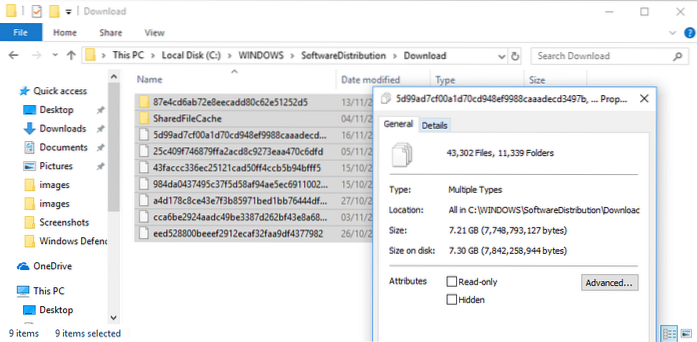
- Go to C:\WINDOWS\SoftwareDistribution\Download. ...
- Select all files of the folder(press the Ctrl-A keys).
- Press the Delete key on the keyboard.
- Windows may request for administrator privileges to delete those files.
- Can you delete Windows update files?
- How do I manually clean Windows update files?
- How do I remove unwanted Windows 10 updates?
- Where are the Windows 10 update files stored?
Can you delete Windows update files?
Windows Update Cleanup: When you install updates from Windows Update, Windows keeps older versions of the system files around. This allows you to uninstall the updates later. ... This is safe to delete as long as your computer is working properly and you don't plan on uninstalling any updates.
How do I manually clean Windows update files?
Windows Update Cleanup Process Manually (Windows 7 / 10)
- Click on Start – Go To My Computer – Select System C – Right click and then select Disk Cleanup. ...
- Disk Cleanup scans and calculates how much space you will be able to free on that drive. ...
- After that, you need to select Windows Update Cleanup and press OK.
How do I remove unwanted Windows 10 updates?
How to Uninstall Windows 10's Unnecessary 'KB4532441' Update
- Open the Windows 10 Start menu.
- Click the gear-shaped Settings icon.
- In the Settings window, go to Update & security > View Update History > Uninstall updates.
- Using the search box, search for “Windows 10 Autopilot update KB4532441.”
- Click to highlight the update, then click “Uninstall” at the top of the list.
Where are the Windows 10 update files stored?
If you are referring to Windows update then the default location of the update file being downloaded from windows update will automatically be saved in C:\windows\software distribution\downloads.